Speak With Us

If you have any queries for BAALHS, use the contact form below.

Name(Required)
This field is hidden when viewing the form

Admin Fields

This field is hidden when viewing the form

Willington and the Mowbrays

After the Peasants' Revolt

By Dorothy Jamieson

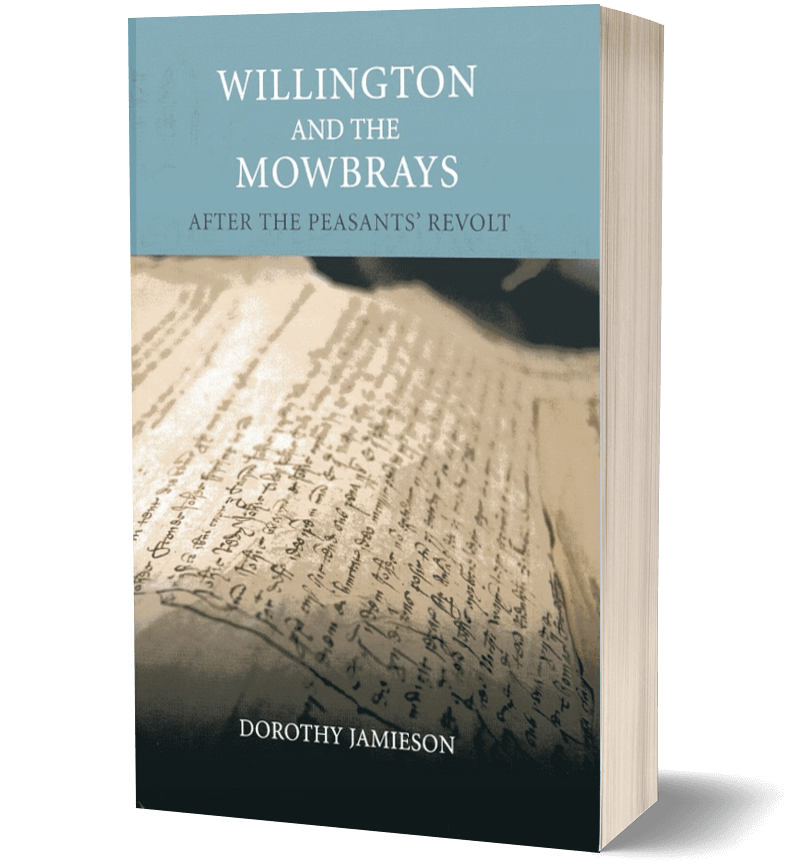
Willington and the Mowbrays book cover

Publisher: Boydell Press, Boydell & Brewer Ltd (2019)

ISBN: 978-0-85155-082-4

RRP: £25

Pages: 251

Further Info: Bedfordshire Historical Record Society Volume 95. Price is £25, but available if ordered on-line at www.boydellandbrewer.com for £18.75 with the offer code BB125 at the checkout.

This book, the first publication in several years from BHRS, represents a welcome addition not just to BHRS’s stable and to the history of Medieval Willington, but to the literature on manorial history and early estate management. Scholarly and well-researched, drawing on a wealth of documentary evidence between 1382 and 1522, this volume charts the history of a single manor parish, Willington, that was dominated by the powerful Mowbray family, the Dukes of Norfolk, and by Katherine Neville, widow of the second Duke, as part of her dower 1432-c.1482.

Many members will be familiar with the author from her work with the National Trust and her passionate interest in the history of Willington. She has an M.A. in English Local History from the University of Leicester and translated the Willington Manor Court Rolls, 1394-1674, about a hundred of which can be found on the Bedfordshire Archives Service web-site.

The book first reviews the evidence, then explores the decline of serfdom and the Peasants’ Revolt. The next chapter examines Willington and its records within the context of two other rural Bedfordshire manors – Blunham Greys and Eggington. Subsequent chapters address ‘Life on the Manor’; ‘The Mowbrays and their Management Networks’; ‘Finances and Assets’; ‘Newnham Priory’; ‘After the Peasants’ Revolt’. There follow six detailed appendices, providing transcripts of key documents – The Terrier of the prior and Convent of Newnham of its Land and Tenements in Willington; By-laws of the Manor; Frankpledge of 1599; Extract concerning a new barn and other buildings; Manor Officials; notes on People and Families; a helpful glossary and bibliography.

Although Newnham Priory held substantial lands in Willington, life in the manor after the Peasants’ Revolt seems to have been influenced less by the Church, than by members of local families, such as the Gostwicks, who would later go on to undertake roles of national importance. Although the structure and language of the manorial records suggests continuity and a hierarchical system of control, tenants took opportunities to better themselves and their families while the lords

of the manor sought to maintain the value of their property and income. This was a where the custom of the manor task due to long-standing problems with declining rental values and ruined buildings. The picture emerges of a relatively stable community where the custom of the manor prevailed, and the local bailiff was a pivotal figure.

Review by Bob Ricketts

Willington and the Mowbrays book cover

Willington and the Mowbrays

This book, the first publication in several years from BHRS, represents a welcome addition not just to BHRS’s stable and to the history of Medieval Willington, but to the literature on manorial history and early estate management. Scholarly and well-researched, drawing on a wealth of documentary evidence between 1382 and 1522, this volume charts the history of a single manor parish, Willington, that was dominated by the powerful Mowbray family, the Dukes of Norfolk, and by Katherine Neville, widow of the second Duke, as part of her dower 1432-c.1482.

Many members will be familiar with the author from her work with the National Trust and her passionate interest in the history of Willington. She has an M.A. in English Local History from the University of Leicester and translated the Willington Manor Court Rolls, 1394-1674, about a hundred of which can be found on the Bedfordshire Archives Service web-site.

The book first reviews the evidence, then explores the decline of serfdom and the Peasants’ Revolt. The next chapter examines Willington and its records within the context of two other rural Bedfordshire manors – Blunham Greys and Eggington. Subsequent chapters address ‘Life on the Manor’; ‘The Mowbrays and their Management Networks’; ‘Finances and Assets’; ‘Newnham Priory’; ‘After the Peasants’ Revolt’. There follow six detailed appendices, providing transcripts of key documents – The Terrier of the prior and Convent of Newnham of its Land and Tenements in Willington; By-laws of the Manor; Frankpledge of 1599; Extract concerning a new barn and other buildings; Manor Officials; notes on People and Families; a helpful glossary and bibliography.

Although Newnham Priory held substantial lands in Willington, life in the manor after the Peasants’ Revolt seems to have been influenced less by the Church, than by members of local families, such as the Gostwicks, who would later go on to undertake roles of national importance. Although the structure and language of the manorial records suggests continuity and a hierarchical system of control, tenants took opportunities to better themselves and their families while the lords

of the manor sought to maintain the value of their property and income. This was a where the custom of the manor task due to long-standing problems with declining rental values and ruined buildings. The picture emerges of a relatively stable community where the custom of the manor prevailed, and the local bailiff was a pivotal figure.

Scroll to Top